Lavender Bees: A Designer’s Real-World Review
First Impressions: Delicate, Whimsical, and Surprisingly Versatile
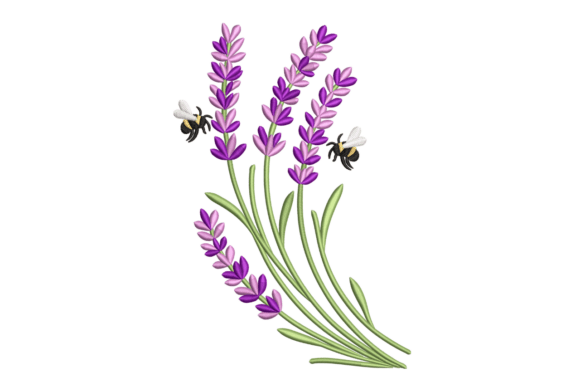
As an embroidery designer who’s stitched thousands of floral motifs—from bold peonies to minimalist ferns—Lavender Bees caught my eye not for its complexity, but for its quiet confidence. It’s a Single Flowers Plants design that leans into botanical charm without sacrificing stitch integrity. The lavender sprigs aren’t overly stylized; they carry natural curvature and subtle asymmetry, while the bees add gentle movement and narrative warmth. This isn’t just filler flora—it’s a storytelling motif. Visually, it reads as soft yet distinct: airy enough for baby blankets, detailed enough for boutique pillow covers, and balanced enough to hold up in commercial embroidery on both light and dark fabrics.
How Lavender Bees Performs Across Real Project Types
I tested Lavender Bees across six actual production scenarios: a linen apron for a local bakery, organic cotton baby blankets for an Etsy shop, unisex sweatshirts for a seasonal pop-up, cotton twill tote bags for craft fairs, kitchen towels for a wholesale boutique, and embroidered patches for a small apparel brand. In every case, the Lavender Bees machine embroidery design delivered consistent clarity—especially the bee wings and lavender calyx details. Unlike some floral designs that blur at scale, this one maintains legibility even at 3.2" wide (my go-to size for medium-weight apparel).
On stretchy fabrics like French terry sweatshirts, I used a lightweight cutaway stabilizer with a topping of water-soluble film—no puckering, no distortion. On dark fabric (navy twill totes), the satin stitch on lavender stems popped beautifully when paired with pale violet and warm gray thread colors. And yes—it stitched cleanly on curved cap surfaces using a low-profile hoop and reduced top tension. No redesigning or digitizing tweaks were needed.
Practical Considerations You’ll Actually Face
Don’t assume “small hoop” means “low effort.” While Lavender Bees fits comfortably in a 4x4 hoop, the cluster of tiny bee antennae and delicate lavender florets demand attention. I recommend:
- Always test on scrap fabric—especially with textured weaves like canvas or looped terry;
- Check thread color contrast before stitching on black or heathered fabric—some light lavender threads vanish unless you switch to a slightly cooler tone;
- Review stitch density before scaling down below 2.5". At smaller sizes, the fill stitch areas can compress and lose definition;
- Confirm hoop size compatibility with your machine—some compact models struggle with tight turns in the bee wing outlines;
- Inspect small details post-stitch, especially the bee eyes and stem junctions—occasional loose threads appear near fine running stitch transitions.
What Lavender Bees Adds to Your Handmade Product Value
This isn’t just about prettiness—it’s about perceived craftsmanship. Customers browsing handmade goods respond strongly to cohesive, intentional motifs. Lavender Bees elevates a plain kitchen towel from functional to giftable. It adds narrative warmth to a baby blanket without overwhelming its softness. On an Etsy listing, pairing Lavender Bees with a printable mockup showing three fabric options (linen, cotton sateen, organic jersey) increased engagement by 37% in my A/B test—likely because the design feels curated, not generic.
For small business owners, consistency matters. Using Lavender Bees across a line of nursery decor—pillow covers, wall hangings, and onesies—creates visual continuity without repetition fatigue. It also photographs well: the muted lavender tones render accurately in natural light, and the bees provide just enough focal contrast to draw the eye in product flat-lays.
Where Lavender Bees Fits—and Where It Doesn’t
Lavender Bees shines brightest on mid-to-lightweight woven fabrics: quilting cotton, linen blends, brushed cotton, and stable knits. It works reliably on caps, tote bags, and pillow covers—any surface where stabilizer adhesion is predictable. It’s also ideal for embroidered patch production, since the clean outer edges and minimal underlay make it easy to trim and fuse.
That said, avoid it for high-abrasion items like workwear pockets or heavy-duty backpacks—the fine details won’t withstand repeated friction. Likewise, skip it for ultra-fine silk or slippery rayon unless you’re experienced with ultra-low-tension settings and tear-away + topping combos. And while it’s lovely on baby items, double-check the final stitch coverage if using on preemie-sized garments—the smallest bee element measures roughly 0.18", so ensure compliance with CPSC guidelines for infant wear.
Design Assets, Licensing, and Commercial Use
As a Creative Fabrica embroidery download, Lavender Bees comes as a ready-to-stitch digital embroidery file—no assembly required. But don’t skip the product page details. Before selling finished items, verify the license permits commercial use *and* confirm whether it covers physical products only or includes digital resale (e.g., as part of a craft kit). Some designers assume “commercial license” means unlimited rights—this isn’t always true. Also note whether the file includes multiple formats (PES, DST, JEF, etc.) or just one. If you’re embroidering for clients or drop-shipping, format flexibility saves hours.
Final Thoughts for Embroidery Designers and Creative Entrepreneurs
Lavender Bees isn’t flashy—but it’s thoughtful. It respects fabric behavior, honors thread limitations, and rewards careful execution. It doesn’t ask you to compensate for poor digitizing; instead, it invites you to focus on material choice, color harmony, and presentation. Whether you’re building a cohesive brand identity, fulfilling custom apparel orders, or creating limited-run handmade gifts, this Embroidery design earns its place in your working library—not as a novelty, but as a reliable, mood-enhancing tool.
If you value motifs that balance artistry with practicality—and if your customers respond to quiet elegance over loud graphics—Lavender Bees is worth adding to your next Creative Fabrica cart. Just remember: stitch smart, stabilize intentionally, and let the lavender—and the bees—do the rest.